Gluten-Free Biscuit Showdown: Almond Flour vs. Oat Flour vs. All-Purpose Blend
Gluten-free biscuits have a reputation problem, and most of it is earned. The first bite is sandy, the second is gummy, and the whole thing slumps under a pat of butter. The flour is usually where things go wrong — and it is also the easiest variable to fix. Almond flour, oat flour, and a standard gluten-free all-purpose blend each push a biscuit in a different direction. Know which lever each one pulls, and you can stop guessing.
What follows is a working comparison of the three, judged on the four things that matter in a biscuit: taste, structure, rise, and browning.
What Each Flour Does in the Dough
Gluten handles three jobs in a wheat biscuit. It traps the gas that baking powder and buttermilk produce, it stretches so the dough can be folded into layers, and it sets into a structure that holds the crumb open. Take it away and those jobs fall to whatever else is in the bowl.
Almond flour brings fat and protein but almost no starch. Oat flour brings starch and some protein, plus a soluble fiber that adds a little viscosity. A gluten-free all-purpose blend is mostly starch — rice flour, potato starch, tapioca starch — usually with xanthan gum added to stand in for elasticity. That is the whole story behind most of the differences you taste.
Almond Flour: Rich, Tender, and Prone to Spreading
Almond flour makes the best-tasting biscuit of the three and the most fragile. The fat content gives it a buttery, almost shortbread quality, and it browns faster than anything else in this lineup, so you get a deep golden top and a nutty aroma before the middle has finished setting. Drop the oven temperature by 25°F and pull them early rather than late.
Structure is the weak point. With no starch and no gluten, the dough needs a binder: an extra egg, a tablespoon of ground flax, or a teaspoon of psyllium husk per cup of flour. Even then the biscuits come out dense and a little sandy, closer to a scone than a flaky layer. Rolling and cutting is a losing battle because the dough is sticky and tears, so treat it as a drop biscuit. Scoop, chill twenty minutes, and bake.
Extra baking powder will not buy you height. It gives a domed top and a hollow pocket beneath it, which is worse than a modest, even rise. Flavor is where almond flour earns its place: sharp cheddar, chives, black pepper, and a little honey all work.
Oat Flour: The Best Crumb, If You Don't Overmix
Oat flour is the closest thing to a wheat crumb without wheat. It has enough starch to brown properly, enough body to hold a shape, and a faint sweetness that tastes like a whole-grain biscuit rather than a substitute. The soluble fiber in oats adds a touch of viscosity, which helps the dough hold together in a way that rice flour alone does not.
Grind it fine. Rolled oats buzzed in a blender or spice grinder until they look like flour — not like sand — give you a tender biscuit. Coarse oat flour gives you grit, so sift out any big flakes.
Oat flour still needs help: about half a teaspoon of xanthan gum or a teaspoon of psyllium husk per cup, plus a rest of ten to fifteen minutes so the flour can absorb the buttermilk. Skip the rest and the dough will look right and bake dry. Mix until it just comes together; oat flour turns gluey fast when you keep working it. The trade-off is flavor — biscuits made with oat flour taste wholesome, which is lovely with honey butter and slightly odd under sausage gravy.
All-Purpose Gluten-Free Blend: The Predictable One
A good one-to-one blend behaves the most like wheat. It rolls, it cuts, it laminates, and it rises the highest of the three, because it is built from starches that gelatinize and set, with xanthan gum already doing the elastic work.
The cost is flavor. Rice flour is neutral to the point of being chalky, and the starches can turn gummy if the biscuits are underbaked or the dough is overmixed. Fat, acid, and salt do the heavy lifting here: cold butter, buttermilk, a generous pinch of salt. Brush the tops with buttermilk or melted butter before baking, or they will come out pale. Bake until the bottoms are deep golden; a pale bottom usually means a gummy center.
Side by Side: The Four Things That Matter
- Taste: Almond flour is the richest and most buttery. Oat flour is the most characterful, with a mild whole-grain sweetness. All-purpose blend is the most neutral, which is either a virtue or a void depending on what you pile on top.
- Structure: Oat flour gives the best crumb, tender but not fragile. The blend gives the best layers. Almond flour gives the most delicate, crumbly biscuit, and it will not hold up to a heavy filling.
- Rise: The blend wins, reliably. Oat flour is a close second and holds its shape well. Almond flour rises least and is happiest as a thick drop biscuit.
- Browning: Almond flour browns fastest and darkest, sometimes before the center sets. The blend browns evenly but stays pale without a wash. Oat flour lands in the middle, with a warm gold and flecks of bran.
The Blend That Beat the Others
None of the three wins on its own. A blend does. For every cup of flour, use roughly two-thirds gluten-free all-purpose blend, one-quarter oat flour, and the rest almond flour — about 10 tablespoons, 4 tablespoons, and 2 tablespoons. The blend supplies rise and handling, the oat flour supplies crumb and structure, and the almond flour supplies flavor and tenderness.
To that cup of flour, add one teaspoon of baking powder, a quarter teaspoon of baking soda, half a teaspoon of kosher salt, and half a teaspoon of xanthan gum only if your blend does not already contain it. Cut in six tablespoons of cold butter, grated or cubed, then add three-quarters of a cup of buttermilk and fold four or five times. Rest fifteen minutes, pat to about an inch thick, cut straight down with a sharp cutter, and bake at 425°F for twelve to fifteen minutes.
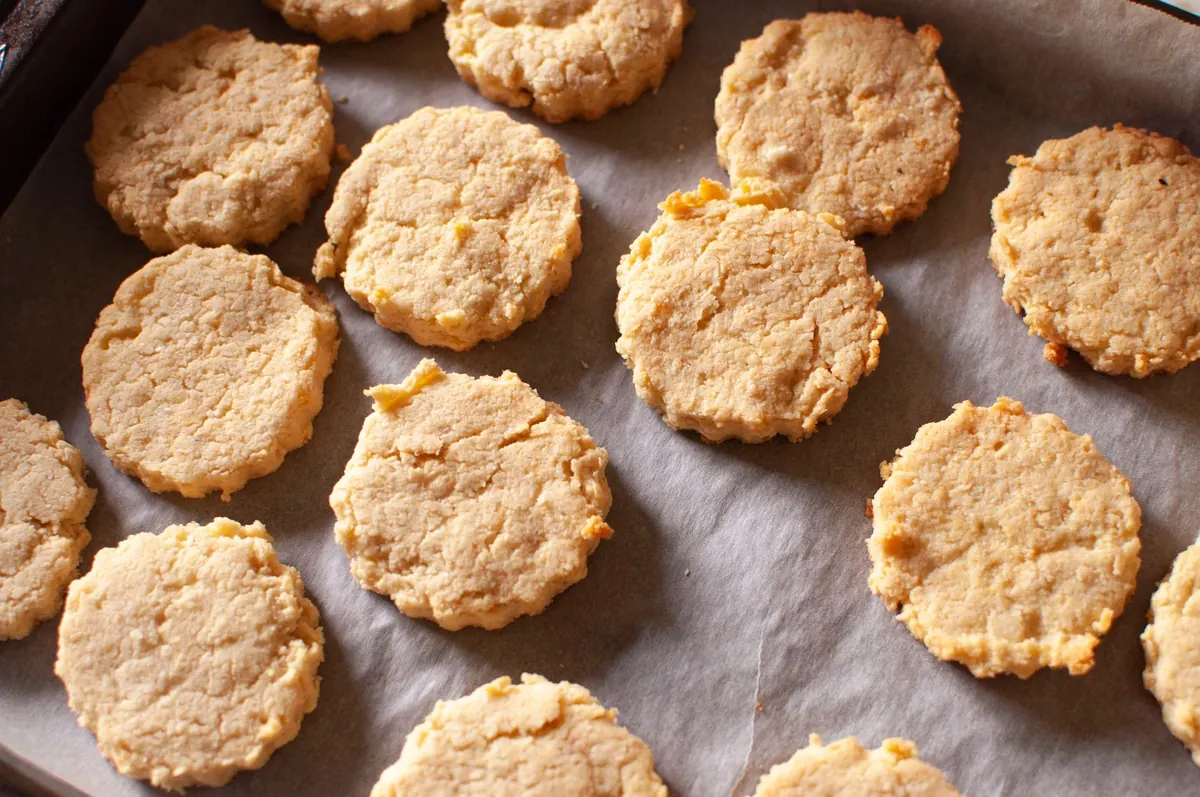
If the dough handles like soft cookie dough, expect a cookie-shaped result. If it holds a cut edge and feels cool and slightly firm, you are on track for a biscuit.
Practical Notes Before You Bake
- Weigh the flour. A cup of almond flour and a cup of oat flour weigh very differently, and scooping compresses both. Grams will save you a batch.
- Rest the dough. Ten to fifteen minutes lets the starches and fibers hydrate. Skip it and the biscuits bake drier than the dough suggests.
- Keep everything cold. Grated frozen butter, chilled buttermilk, and a bowl that spent ten minutes in the freezer give you the steam pockets that pass for layers.
- Cut straight down. Twisting a cutter seals the edges and stops the rise. Press and lift.
- Wait ten minutes. The crumb sets as it cools. Cutting immediately gives you the gummy texture you were trying to avoid.
If you are avoiding gluten for a medical reason, use oats labeled certified gluten-free and check with a doctor or dietitian about your own needs. Flour choices are one part of a safe kitchen, not the whole of it.
Start with the blend, note what you would change — more almond for flavor, more oat for structure, more blend for height — and adjust the next batch by a tablespoon or two. That is how a good gluten-free biscuit gets made: not in one try, but in three.
Photo: Mikhail Nilov / Pexels

Beginner's Checklist for Buying Biscuits Online: Shipping, Freshness, and Packaging
A practical checklist for judging online biscuit sellers on shipping speed, freshness and packaging, plus...

Biscuit Baking Temperature Guide: Convection vs. Conventional Ovens
A practical guide to baking biscuits in convection and conventional ovens, covering temperature tweaks,...
About Us